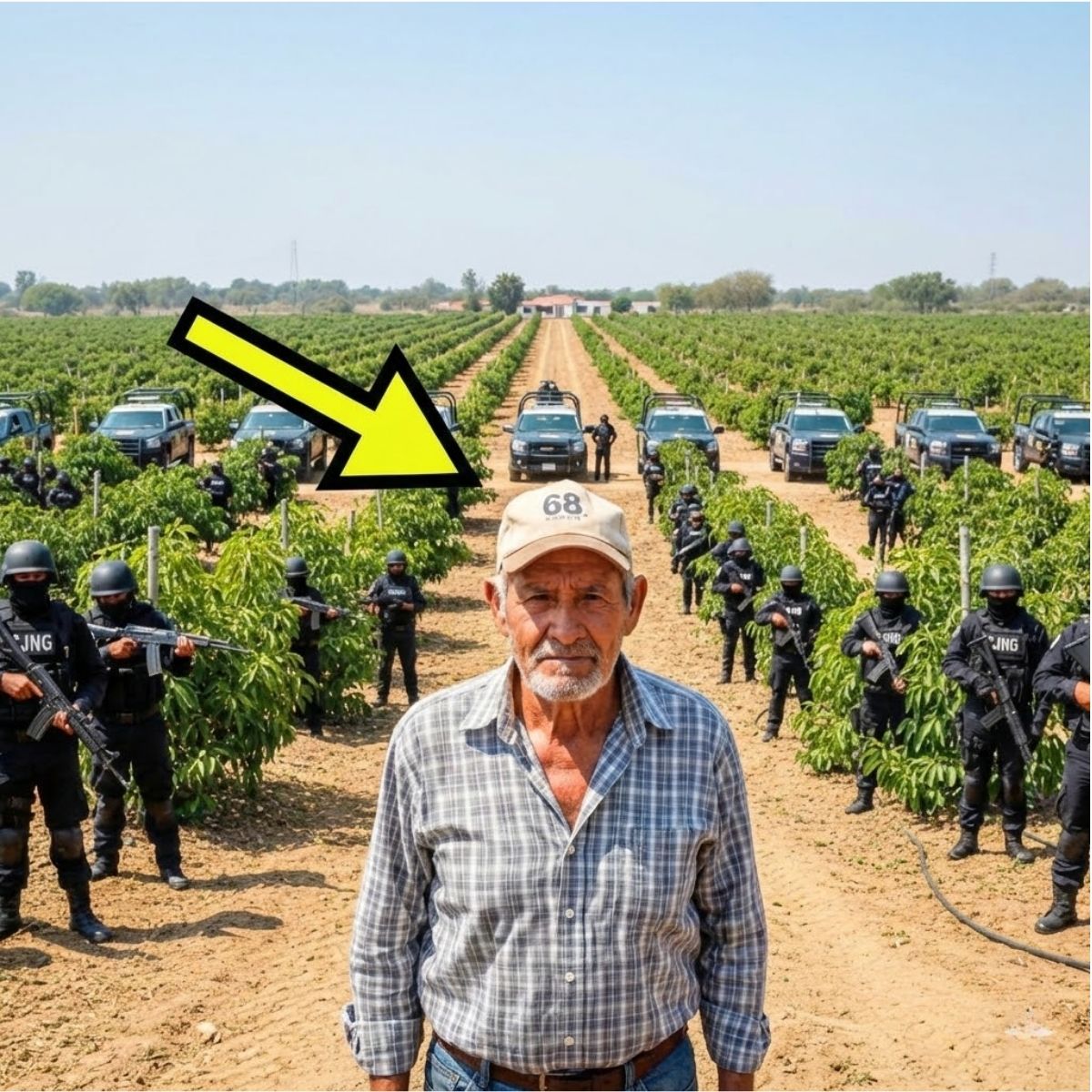
Se Negó a Pagar Cuota al Sicario — Al Amanecer, 250 Hombres del Cártel Rodearon Su Huerta…
At 4:47 a.m. on Tuesday, March 14, 2025, Onésimo Reyes woke up the way old men sometimes do—before the sun, before the birds, before the world has any right to be awake. But this time it wasn’t his knees or his bladder that pulled him out of sleep.
It was engines.
Not one. Not two. A low, rumbling chorus of diesel motors idling in the dark, surrounding his home like a slow, patient animal.
Onésimo lay still for a moment, listening. The sound wasn’t passing traffic. It wasn’t a neighbor starting a tractor. It was organized. Measured. Positioned.
He slid out of bed, barefoot on cool cement, and walked to the window. The curtain was thin and worn, the kind you keep because it still does its job. He pulled it back.
And his body forgot how to move.
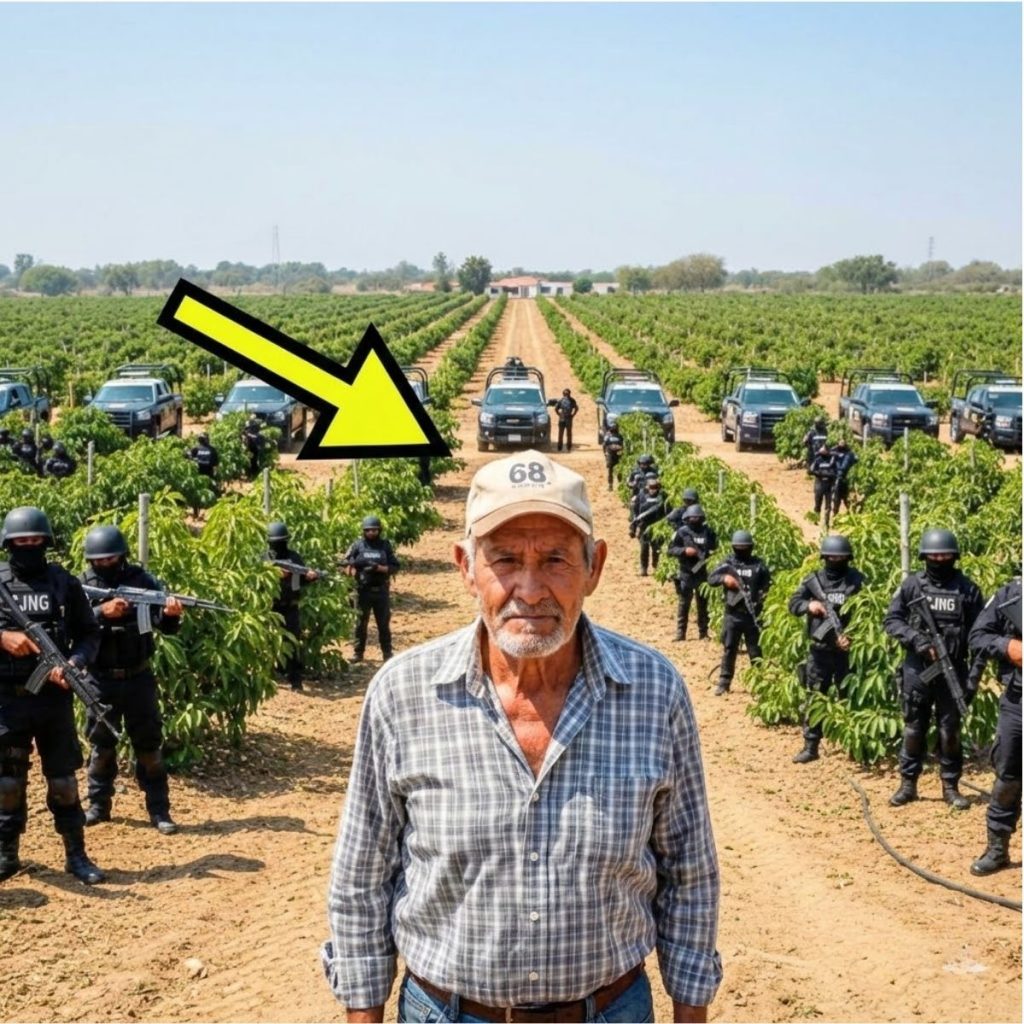
Forty-seven black trucks had formed a perfect ring around his avocado orchard—twelve hectares of trees he’d planted, pruned, defended from drought, pests, and time. One truck about every fifty meters, like a fence made of metal and menace. Men were climbing out—four, five, sometimes six from each vehicle—rifles, tactical vests, radios. They didn’t shout. They didn’t fire. They didn’t even hurry.
They simply took their places and stared toward the center.
Toward his house.
Onésimo did the math without meaning to. Forty-seven trucks. Five men per truck on average. Two hundred thirty-five… maybe more.
Two hundred fifty armed men.
For one farmer.
In the living room, his German shepherd lifted his head and growled low, a warning that felt almost human. Capitán had been with him eight years. He’d seen storms and snakes and strangers at the gate. He’d never growled like this.
Outside, the sky was still black and full of stars. The air smelled like wet earth and gasoline. The orchard that had fed his children and paid for their schoolbooks had become a cage.
Onésimo didn’t scream. He didn’t run. He didn’t pray out loud. He stood there in the half-dark, breathing slowly, because he already knew why they’d come.
He’d said no.
Three weeks ago, he’d looked at men with tattoos crawling up their necks and told them he would not pay them a single peso.
And now, with two hundred fifty rifles pointed at the place he called home, the future was no longer a question. It was a clock, ticking.
He got dressed like he always did: jeans, a plaid shirt, work boots. In the cracked bathroom mirror, he saw an old man with white hair and hands like bark. A face built by forty years under the sun. A face that had buried a wife, raised three children, and stayed when others fled.
Then he went downstairs, turned on the stove, and made coffee.
Not because he wasn’t afraid.
Because fear wasn’t allowed to be the last thing he tasted.
Capitán watched him with confused eyes as Onésimo warmed tortillas, spooned yesterday’s beans into a pan, and ate slowly at the wooden table. Outside, men waited in silence. Inside, a farmer chewed like it was a normal morning—because somewhere deep in his chest, he’d made peace with the idea that his life might end on his own land.
And as the first thin line of dawn began to show, Onésimo understood something with brutal clarity:
What happened next wouldn’t just be about him. It would become a message for everyone who worked the soil in Michoacán—and everyone who had been taught to bow their head.
Twenty-one days earlier, it had been an ordinary Monday afternoon. Onésimo was pruning a dry branch off tree number 156 when he heard a truck roll into his property. No knock. No waiting at the gate. They opened it like it belonged to them.
Three men got out.
The leader looked about thirty-five, slim, calm. Tattoos climbed from his neck up behind his ear. The other two were younger and heavier, hands tucked into their pockets like they were holding something warm and deadly.
They walked straight toward him without greeting.
“Don Onésimo,” the tattooed man said, voice almost friendly. That gentleness was what made it terrifying. “We’re here to introduce ourselves. This zone has new administration. We’re CJNG.”
Onésimo set down the pruning shears and wiped his hands on his jeans. He stared at them until the friendly mask started to crack.
“I don’t need protection,” he said. “I’ve worked this land forty years.”
The man smiled, but it wasn’t joy. It was a predator showing teeth.
“It’s not optional,” he said. “All avocado producers in this region pay a fee. Fifty thousand pesos a month. That’s nothing compared to what you produce.”
Fifty thousand pesos. Six hundred thousand a year. Nearly half his profit—gone, not to fertilizer or workers or irrigation, but to men who contributed nothing but fear.
Something hot rose in Onésimo’s stomach, older than anger. It was the fury of someone who has lived honestly in a place where honesty gets you punished.
“I’m not paying anything,” he said, clear and steady.
The younger man on the right let out a nervous laugh. The heavier one stepped forward, but the leader lifted a hand to stop them.
“Don Onésimo,” he said, and now the sweetness drained out of his tone, “I’ll be straight because I respect you. You’re older. We don’t want problems. But if you don’t pay, we’ll burn your orchard. We’ll kill your livestock if you have any. And if you stay stubborn, we’ll kill you. Simple.”
Onésimo didn’t look away.
He’d faced drought that killed half his trees. Pests that almost bankrupted him. He’d buried his wife and kept going because his children still needed breakfast in the morning.
Three bullies weren’t going to rewrite his life.
“Do what you have to do,” he said. “But you’re not taking a peso from me.”
The tattooed man’s smile vanished. His eyes became cold, professional.
“You have a week to think,” he said. “Next Monday we come back. Either you have the money, or you start saying goodbye to your orchard.”
When they left, their tires kicked up dust. Onésimo stood between his trees, watching the empty road, feeling the silence after violence like a bruise.
Capitán came up and licked his hand.
Onésimo scratched his dog behind the ears and whispered, “I’d rather die than pay.”
For seven days, he lived like nothing had changed—and like everything had. He woke at 5:30, checked irrigation, pruned, sprayed for pests. He ate alone. He watched television at night. He lay in bed early, staring at the ceiling.
But he also made calls that revealed the truth of the place he lived.
He called his three children in California. They begged him to pay, to sell, to leave and come north.
“This land is my father’s legacy,” he told them. “And it’s what I meant to leave you. I’m not running.”
He called the municipal police. The commander spoke with the tired voice of a man who’d already surrendered.
“We can’t do anything,” the commander said. “CJNG controls the region. If we intervene, they’ll come back worse. Better to pay.”
He called the National Guard. They took his information, promised an investigation, never called again.
He called the army’s anonymous line. They said they’d forward the report. Nothing.
By the end of the week, Onésimo understood what everyone in Michoacán already knew in their bones: he was alone. The state wouldn’t protect him. Either they were scared, or they were bought, or they were both.
So on the night before the deadline, Onésimo did something he never imagined he’d do. He pulled out his father’s old twelve-gauge shotgun, cleaned it with oil, checked the action, and bought shells in town. He hid them in a metal box under his bed.
He wasn’t delusional. A shotgun wouldn’t beat rifles and grenades. But it would let him die standing.
And that mattered to him more than surviving on his knees.
On Monday, the men returned—five trucks this time, fifteen armed men. The tattooed leader didn’t pretend to be polite.
“Don Onésimo,” he said, “did you bring the money?”
“I don’t have your money,” Onésimo replied. “I told you.”
The leader sighed like he was dealing with a stubborn child. Then he nodded.
Four men walked toward the nearest avocado trees and pulled out machetes.
The first trunk fell.
Then another.
Trees that had taken fifteen years to grow were dropping in seconds like bodies.
Onésimo felt each chop like it was in his own ribs. Those trees were history. They were his wife’s laughter in the kitchen, his children running between rows, the quiet pride of watching something live because you cared for it.
“Stop!” he shouted.
They didn’t.
He ran into his house, grabbed the shotgun, and came back out. His hands shook, but he raised the barrel and fired into the sky.
The blast cracked the morning.
Everything stopped.
Fifteen men turned toward him, some laughing, others lifting their rifles.
The leader walked slowly up to within a few meters. His voice was calm, almost pitying.
“Don Onésimo,” he said, “put it down before you do something stupid. You’re not a killer. You’re a farmer. We don’t want to kill you… but if you make us, we will.”
Onésimo’s arms trembled. He had one shell chambered and more in his pockets. He could take one or two men before they erased him. It wouldn’t save the orchard. It would only speed up his death.
So he lowered the shotgun, slowly, swallowing the taste of humiliation.
The leader nodded, satisfied.
“I’ll give you one last chance,” he said. “Two weeks. March 14. Fifty thousand pesos. If you don’t pay, we won’t cut trees next time. We’ll burn everything. And you’ll leave in a black bag.”
They drove away, leaving fifteen butchered trees on the soil like a warning.
Onésimo dropped to his knees beside one fallen trunk and cried until his throat hurt. Not only for the trees—for his country, for the insanity of being an honest man in a place where honesty was a liability.
Then he wiped his face, stood up, and decided something that would change everything.
He would not pay.
He would not flee.
He would not kneel.
If they came to kill him, they’d have to look him in the eyes while they did it.
For the next fourteen days, he documented everything. Videos of the cut trees. Photos of tire tracks. Notes of dates, times, license plates, tattoos, faces. He saved it all onto a USB drive, made three copies, hid one, gave one to a trusted neighbor, mailed one to his eldest son in Los Angeles with one instruction:
“If something happens to me, give this to the media. Let all of Mexico see what’s happening here.”
He also did something quieter. Every night he walked his orchard, measuring distances, memorizing trenches and rocks, learning every advantage the land could give him. If the cartel came, his only weapon might be knowledge.
He called authorities again. One captain sounded different. He asked for the files. Onésimo sent them.
Then… nothing.
Two days passed. No response. Calls went unanswered. Hope died like a candle in wind.
On March 13, the day before the deadline, a number he didn’t recognize called.
“Don Onésimo Reyes?” a voice said.
“Yes.”
“It’s Scorpion,” the man said. “CJNG plaza boss in Uruapan.”
Onésimo felt his stomach tighten. The name was famous. A man tied to dozens of deaths.
“I’ll speak plainly,” Scorpion said. “You have guts. I respect that. But you’re playing with fire. Tomorrow is the last day. If you don’t pay fifty thousand, I’ll send two hundred fifty men to surround your orchard. We won’t touch a tree. We’ll just wait until you come out, and when you do, we’ll execute you in front of the region. Not for you—for the message. If you don’t pay and nothing happens, everyone stops paying. We can’t allow that.”
Onésimo listened, hands trembling, and then he inhaled slowly.
“Do what you have to do,” he said.
He hung up and didn’t sleep. He sat on his porch under the stars with Capitán at his feet and asked himself what people always ask in the darkest hours:
Is this worth dying for?
It wasn’t pride. It was the future. If he paid once, he’d pay forever. Then his sons would pay. Then their children. Fear would become inheritance.
Somebody had to say enough.
At 4:47 a.m., the engines arrived.
By 6:15, the sun began to rise, orange light spilling over the avocado trees. The orchard had never looked more beautiful, which felt like a cruel joke.
Onésimo walked out to the center of his property, stood in a clearing, crossed his arms, and waited.
Two hundred fifty armed men watched him from the ring.
At 7:30, a black armored Suburban rolled up. A man stepped out wearing designer jeans and exotic boots, four bodyguards behind him.
Scorpion.
He walked the long path—nearly two hundred meters—like he wanted the moment to stretch. He stopped two meters from Onésimo and studied him like a puzzle.
“Two hundred fifty men,” Scorpion said. “Forty-seven trucks. Do you know what this costs me?”
Onésimo didn’t answer.
“One last offer,” Scorpion said. “Pay fifty thousand for this month. I’ll forgive the rest. You keep your orchard. We keep our business. Everybody wins.”
“No,” Onésimo said simply.
Scorpion exhaled, frustrated. “Why? Why prefer death?”
Onésimo looked at him and spoke with a calm that surprised even himself.
“I win by dying like a man,” he said, “not like a dog.”
Scorpion stared at him for a long second. Something flickered in his face—respect, annoyance, maybe even regret.
“Fine,” he said. He lifted his radio. “All teams. Prepare. Concentrated fire on the target.”
Around the ring, rifles rose in unison.
Onésimo heard the metallic clicks of safeties flipping off. He closed his eyes. He thought of his wife. His sons. The taste of coffee. His hands in soil.
The air went unnaturally still.
And then, from the north, a sound tore the morning open.
Helicopters.
One. Two. Three. Then more—Black Hawks flying low, rotors pounding the sky. Dust and leaves exploded upward. Soldiers leaned out of open doors with rifles aimed downward.
A voice boomed through a loudspeaker, echoing over the valley:
“Attention. This is the Mexican Army. You are surrounded. Drop your weapons and get on the ground. This is your only warning.”
Onésimo opened his eyes.
Convoys surged in from the main road—military trucks, armored vehicles, dozens of them. Hundreds of soldiers poured out, moving in practiced formation.
The trap flipped.
Now the cartel’s two hundred fifty men were surrounded by more than four hundred army personnel.
Scorpion’s head snapped from side to side, calculating. Some of his men began lowering rifles, hands shaking. Others held them up as if pride could stop bullets.
An officer walked to the center of the orchard beside Onésimo, immaculate uniform, brigadier general insignia on his shoulders.
He looked at Scorpion as if he were already arrested.
“I have warrants for forty-seven members of your organization,” the general said. “We’ve monitored your communications for three weeks. We knew you’d come today. We knew how many. We knew where you’d position.”
Scorpion’s face went pale. “This is a trap.”
“This is justice,” the general replied. “Don Onésimo was not alone. We needed you all in one place.”
Then the general turned slightly toward the old farmer and spoke quietly, almost respectfully.
“The captain who received your report brought it to me,” he said. “I’m General Macario Villaseñor. We built this operation from your evidence. We couldn’t move too early. We needed them confident. We needed them gathered.”
Onésimo swallowed hard. “So I almost died…”
“Not for nothing,” the general said. “For principles. And those principles just took down an entire plaza.”
Over the next twenty minutes, the orchard became a scene Onésimo never thought he’d witness in his lifetime: cartel men dropping rifles, kneeling, hands behind heads. Truck after truck seized. Weapons and ammunition stacked like a nightmare inventory.
Scorpion was the last to surrender. As soldiers cuffed him, he looked back at Onésimo.
“You beat me, old man,” he said quietly. “I respect it.”
Onésimo didn’t reply. His eyes were tired—tired in a way that went deeper than fear.
In the days that followed, the story went everywhere. Cameras arrived. Reporters called him brave, stubborn, heroic. People argued online about whether anyone should ever resist like that.
Onésimo gave one interview. Five minutes. Standing beside the fifteen cut trees.
“I’m not a hero,” he said. “I’m just a man tired of being afraid. Somebody had to say enough.”
Those words travelled farther than he expected. Other producers began reporting extortion. Some began organizing. Investigations opened. Arrests followed.
And yet, in quiet moments, Onésimo knew the truth no headline wanted to say out loud: cartels don’t vanish. They adapt. New bosses replace old ones. Revenge is patient.
Threats came. Then protection. Soldiers lived at the entrance of his orchard. Onésimo hated feeling like a prisoner on his own land, but he understood what it meant to be a symbol.
A year turned into two.
Then, when the protection finally ended, the silence felt heavier than gunfire.
And when new men came—smarter, quieter, younger—and took Capitán to force Onésimo’s hand, the old farmer learned the cruelest lesson of all:
You can win a battle with courage… and still be defeated by love.
He paid once, just to bring his dog home alive.
And afterward, when the threats shifted from him to photos of his grandchildren in California, Onésimo finally did what he’d refused to do for years.
He left.
Not because he stopped believing in dignity.
Because dignity doesn’t mean sacrificing the people you love to prove a point.
He flew to California with two suitcases and an old dog with gray in his muzzle. His orchard kept producing under management. Michoacán changed in small ways—new protection programs, quicker responses, fewer extortions in some areas.
Nothing perfect.
But something started.
Years later, in a quiet American backyard, his youngest grandson asked him, eyes wide with childlike awe, if it was true he once faced two hundred fifty bad men alone.
Onésimo knelt down so their faces were level.
“Yes,” he said. “And I was very afraid.”
“Then why did you do it?” the boy asked.
Onésimo looked at the child’s small hands, clean and safe, and felt something tighten in his throat.
“Because there are things bigger than fear,” he said. “Dignity. Doing what’s right. Standing up even while you’re shaking. That’s what makes you a man—not weapons, not violence. Just the decision to not live on your knees.”
The boy hugged him and whispered, “When I grow up, I want to be like you.”
Onésimo held him close and shook his head softly.
“No,” he said, voice breaking into something like prayer. “When you grow up, I want you to live in a country where you never have to be like me. Where you can work in peace and nobody threatens you. That’s my real dream.”
That night, Onésimo sat on his porch under familiar stars, Capitán sleeping at his feet, older now, breathing slow. The same sky he used to watch over his orchard in Michoacán.
He thought about what he’d lost—land, freedom, years of quiet life. He thought about what he’d gained—respect, a spark of change, the knowledge that he had said no when everyone expected him to say yes.
And he reached a conclusion that wasn’t clean, but it was true.
He didn’t regret standing up.
He regretted that standing up had to cost so much.
Because in the end, dignity shouldn’t be something you have to fight a war to keep.
But if you ever find yourself in a moment where fear is asking you to kneel—remember this:
Sometimes the bravest thing a person can do isn’t winning.
It’s refusing to be owned.