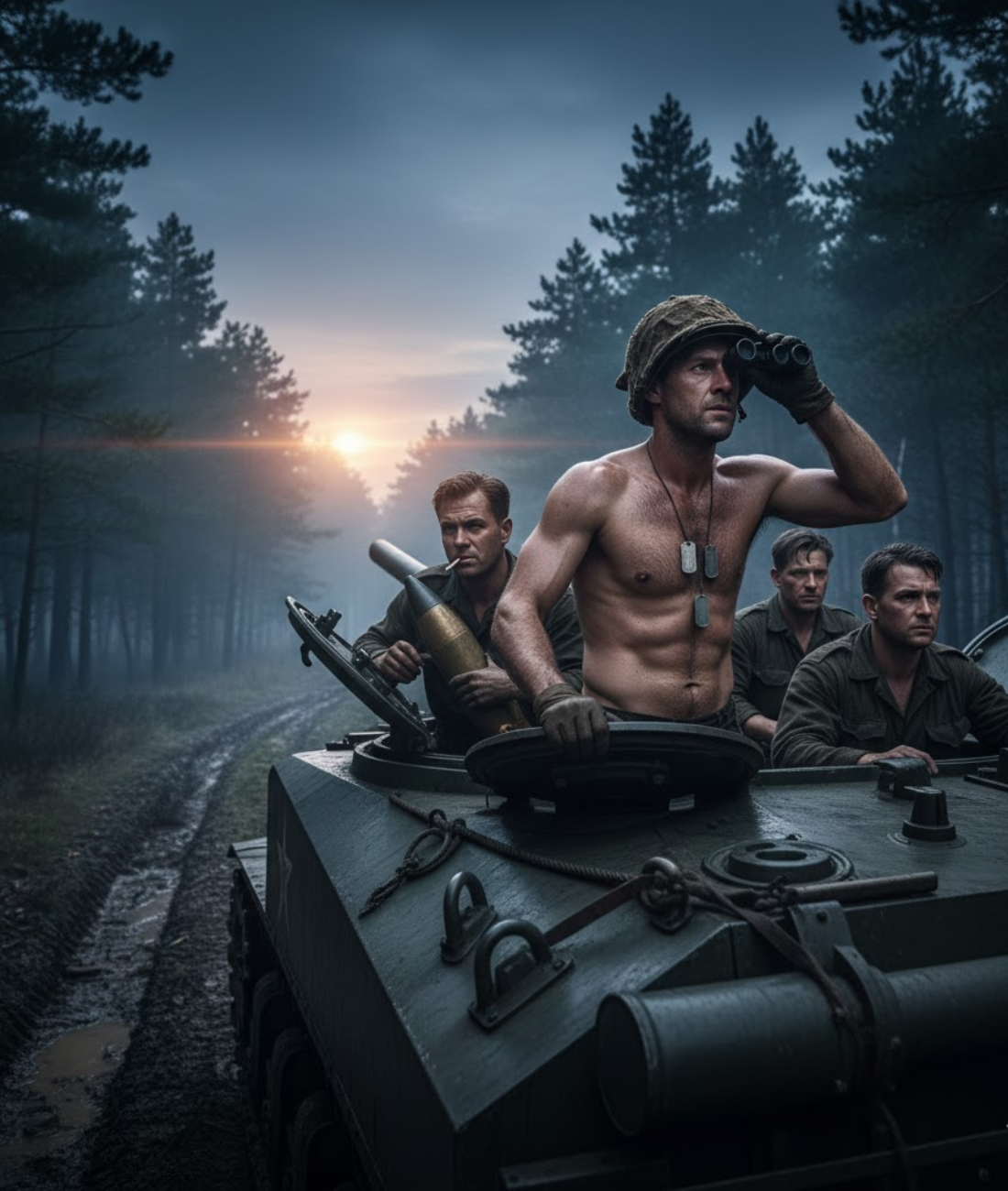
The metal hatch felt cold under Lafayette Pool’s gloved hands as he stood half-exposed in the commander’s position, shoulders above the turret ring, scanning the tree line in the pre-dawn dark.
His orders that morning had been clear—almost protective.
No spearheading today, Pool.
You and your crew are heading home for a war-bonds tour.
Stay on the flank. Stay safe.
Pool had heard the word safe enough times in the last three months to know it didn’t mean anything.
In war, safety was an illusion you borrowed for a few minutes at a time, and you never knew when somebody was going to come collect it.
The Sherman beneath him was painted with white block letters on the hull—IN THE MOOD—the third time those words had been slapped onto American steel under his command. The first two tanks bearing that name were gone. Burned. Abandoned. Left behind as scorched proof that even the best crews eventually run out of luck.
And this one—this third In the Mood—was about to join them.
Pool didn’t know the details yet. He just felt the pressure of the day. The way the air held the smell of diesel and old gunpowder. The way radios crackled with low voices and clipped call signs. The way engines rumbled in the distance like thunder you couldn’t see.
Somewhere ahead, inside the buildings and rubble of Müsterbusch, German defenders waited with 88s and Panzer rockets—tools Pool had learned to fear without ever giving them the dignity of making him hesitate.
Because Pool’s entire way of fighting was built on one brutal principle:
Strike first. Strike hard. Close the distance before they can use their advantage.
That aggression had carried him through two destroyed tanks, twenty-one major attacks, and enough close calls to make a normal man start believing in signs.
But on this morning—home just days away—his luck was about to run out.
And when it did, it wouldn’t just end a war-bonds tour.
It would end the most devastating tank-killing spree in American military history.
To understand why Lafayette Pool was the man standing in that hatch in Müsterbusch, you have to go back before the hedgerows and the burning Shermans and the German Panthers.
You have to go back to South Texas, where the land is flat and stubborn and the heat teaches you discipline whether you want it or not.
July 23rd, 1919. A small place near Odum, Texas. Lafayette Green Pool was born five minutes after his twin brother, John Thomas. Later there would be a sister too—Tenny May—and a family that ran on the same fuel that ran most rural families in that era: work, pride, and the expectation that you carried your weight.
A Texas farm in the 1920s wasn’t romantic. It was endless labor—sunrise to sunset—cattle, fences, equipment repairs with whatever you could scrounge. Electricity was a luxury. Running water came from a well. Entertainment came from a radio if you could afford batteries and from church gatherings when Sunday finally arrived.
Pool grew up with hands that were calloused before they ever touched a weapon. Rope and plow before steel and fire.
He also grew up with something else.
Competitiveness.
Not the casual kind. The kind that makes a boy look at the world and feel like he’s losing if he isn’t winning.
In high school, he stood out in football. Fast, aggressive, hungry. But he wasn’t just an athlete. He had the mind of someone who wanted to solve problems. He didn’t want to only hit people—he wanted to understand how systems worked.
After Taft High School, he went to a tough preparatory school and graduated as valedictorian in 1938. Then he enrolled in engineering at Texas College of Arts and Industries in Kingsville.
He could’ve become an engineer. A man with clean hands and a steady life.
But there was another part of him that never quite sat still long enough to accept that future.
Boxing.
Pool fought amateur bouts in the 165-pound class and ran up a record that sounded like a made-up legend: 41 wins, zero losses. He won a Golden Gloves championship in New Orleans and got invited to nationals.
He declined.
Not because he was afraid.
Because he had decided engineering mattered more than chasing a professional fight career.
Still, the ring left marks on him in ways that weren’t visible.
Boxing teaches you a simple truth: you don’t win by hoping. You win by acting. You win by timing. You win by being willing to step into danger and throw first.
Those lessons would follow him into a different ring.
A steel one.
June 14th, 1941. Fort Sam Houston.
Pool was twenty-one and still in school when he walked into a recruiting office and enlisted in the U.S. Army—six months before Pearl Harbor. America was officially neutral, but the world was already burning, and everybody who paid attention knew neutrality was temporary.
Young men faced a choice: wait to be drafted or enlist and at least have some say in what uniform you wore.
Pool didn’t wait.
He signed.
And the Army took that lean South Texas farm boy and started turning him into something else.
He ended up in the newly forming 3rd Armored Division, activated in 1941—later nicknamed Spearhead, because it went first, broke things open, and kept going.
Pool was assigned to the 32nd Armored Regiment. He would become a tank commander, not by paperwork or politics, but by being the kind of man other men follow when the training becomes hard.
Training was relentless. Operating, maintaining, fighting from armored vehicles in every condition they could simulate. Gunnery drills until you could identify targets and engage in seconds. Radio procedures until your voice stayed calm even when your hands shook. Field exercises across terrain that became a classroom and a test.
Pool’s aggression got noticed immediately. He wasn’t reckless. He was intense. He drilled his men until their work became instinct.
Load. Aim. Fire. Reload.
Identify target. Range. Adjust. Fire again.
He demanded perfection because he understood something a lot of people don’t understand until it’s too late:
In combat, seconds are life.
The Army offered him a commission at one point.
Pool refused.
Commissioned officers often commanded from higher levels, coordinating from command posts. Pool wanted to fight from a tank. He wanted to lead from where he could see the battlefield and make split-second decisions.
He wanted to be close to his crew.
Close to the fight.
That decision defined his war.
By late 1943, the division crossed the Atlantic and staged in England, training and waiting. Waiting was its own kind of torture. Everybody knew the invasion was coming. Nobody knew exactly when.
And in July 1944—right around the time the division was already committed to Europe—Pool had that strange encounter that later became part of his legend: sparring with Joe Louis during an exhibition.
Pool went in aggressive, because that was his nature.
Joe Louis, the heavyweight champion, responded like a professional teaching a lesson: dominance without cruelty, showing Pool the difference between talent and mastery.
Pool walked away bruised but sharper.
Aggression matters, but so does timing.
So does control.
So does understanding that the other side might be better than you—and you still have to find a way to win.
June 24th, 1944. Omaha Beach, Normandy.
The 3rd Armored came ashore eighteen days after D-Day. Rain turned everything into mud. The beach still looked like a scar—wrecked craft, broken fortifications, supply dumps stacked like the country was building a whole new world on sand.
Pool’s first Sherman rolled up off the beach and into France.
And now training became reality.
If you’ve never been in a tank, it’s hard to explain what it feels like inside one. It’s loud, cramped, vibrating. The air smells like oil and cordite and metal. You live inches from ammunition. You sweat. You slam into things. You see the world through narrow angles and periscopes unless you’re willing to ride exposed.
Pool rode exposed.
It wasn’t bravado. It was calculation.
Buttoned up, you survive fragments.
Buttoned up, you also see less.
And seeing less in a tank is how you die.
Pool’s crew mattered as much as Pool did. He didn’t just accept whoever got assigned; he cared who sat in that steel with him because in a tank crew, you aren’t coworkers—you’re one nervous system.
His driver, Wilbert Richards, nicknamed Baby for his baby face, was small and wired and could maneuver a Sherman like it was a pickup truck. Pool used to brag Baby could parallel park a Sherman in New York City rush hour.
His assistant driver and bow gunner, Bertrand Close, was only seventeen—called Schoolboy—youth in glasses with a vicious streak when that front machine gun opened up.
His gunner, Willis Ol, called Groundhog, was calm, methodical, always with his eye pressed to the sight like it was glued there.
His loader, Delbert Boggs, called Jailbird, was skinny but strong and fast—one of those men who can lift heavy things all day because they’re built out of stubbornness.
And then there was Pool—War Daddy to them. Not because he was old—he wasn’t. But because he was both protector and aggressor, the man who pushed them into danger and pushed them through it.
The first tank got its name like all tanks did.
Pool chose In the Mood, after the Glenn Miller song—upbeat, confident, unstoppable. It fit his approach to fighting: strike first, keep moving, never give the enemy time to settle.
June 29th, 1944. Normandy.
Pool’s first real fight wasn’t a cinematic clash of tanks in an open field. It was hedgerows and uncertainty.
Normandy bocage wasn’t terrain—it was a weapon.
Earth walls three or four feet high crowned with dense vegetation. Every field boxed in by green fortifications. Visibility measured in yards, not miles. German infantry and guns could hide behind every hedge, invisible until you were close enough to die.
Early on, American tanks tried to climb hedgerows, and when they did, they exposed their bellies—the thin armor underneath. Germans killed them like hunters shooting animals as they crest a ridge.
Americans adapted, welding steel beams onto Shermans to punch through hedges instead of climbing over them. It helped, but it didn’t make the country safe.
Nothing made the country safe.
Pool’s first day of combat was chaos—radio chatter, gunfire, smoke drifting across fields. His crew worked like a machine, destroying enemy vehicles and blasting positions when they spotted them.
And then, inside a village street where the buildings made echoes and shadows, the first In the Mood died.
A German soldier with a Panzerfaust stepped from a doorway and fired at close range. The impact wasn’t “loud” in the way people imagine. It was a violent metal punch that rang through the tank like a bell.
Pool didn’t hesitate.
“Bail out!”
His crew scrambled out fast—because in a tank, the difference between living and dying is often measured in how quickly you can get out before ammunition cooks off.
They escaped.
The tank didn’t.
Pool watched it burn and felt the reality settle into his bones:
Your tank is not a castle.
It’s a vehicle.
And if you don’t respect that, you die with it.
That first In the Mood lasted five days in combat.
Pool and his men survived.
And within days, they were assigned a replacement.
The second tank was a better Sherman—upgraded with a 76mm gun and “wet stowage,” the system designed to reduce the chances of the tank turning into a torch when hit. It mattered. It saved lives. It didn’t make you invincible.
Pool painted In the Mood on it again.
Because if you’re going to keep fighting, you don’t surrender your identity every time something gets destroyed. You carry it forward.
And carry it forward he did.
Over the next weeks, he and his crew became what the 3rd Armored Division was built to be: spearhead. Always forward. Always pushing. Always taking risks because the war of movement demanded risk.
Pool’s tactics were simple but lethal: close distance, fight at ranges where German advantages shrink, maneuver for flank shots, fire fast, and never hesitate.
That approach—combined with crew drill so tight it looked like instinct—made him deadly.
It also made him a magnet for danger.
Because the lead tank takes the first hit, every time.
And the war doesn’t let you lead forever without paying.
Part 2
By early July 1944, the men around Lafayette Pool started saying his tank showed up in places it shouldn’t have been able to reach.
Not because it could fly.
Because Pool never stopped moving.
He was the kind of commander who treated hesitation like a disease. He didn’t give the Germans time to settle into a perfect ambush. He didn’t wait for someone else to take the first hit. He pushed forward hard enough that the enemy’s plan—no matter how good—had to adjust on the run.
That was his edge.
In a war where German guns and armor were superior in clean, long-range theory, Pool kept dragging them into close, ugly reality where speed, crew drill, and nerve mattered more than spec sheets.
His second In the Mood was the upgraded Sherman with the 76mm gun and wet stowage, the best American compromise they had at the time. Still not a Panther. Still not a Tiger. But in Pool’s hands it was a weapon that forced German crews to make mistakes.
And Pool lived for mistakes.
The hedgerows of Normandy taught him how to read terrain like a boxer reads a shoulder twitch. He didn’t just look at a field. He looked at shadows, sight lines, likely gun positions, places where an experienced enemy would choose to hide.
He learned to spot the “wrongness” in a hedgerow—the branch that didn’t sit like the others, the disturbed earth where a gun trail might have been dragged, the gap that seemed too neat.
He learned to think like the Germans.
Then he punished them for it.
His crew—his “pups”—became an extension of him. When Pool’s voice cracked in the headset, they moved without thinking.
Driver—stop.
Gunner—on the way.
Loader—up.
Bow—cover.
Fire.
The sequence was so fast it felt unreal to anyone watching from outside.
Other tanks would spot a target, hesitate, adjust, argue over ammo type, and by the time they fired, the Germans had fired first.
Pool didn’t allow the enemy that courtesy.
He believed in first shots like some men believe in prayer.
Because first shot usually meant survival.
The battles blurred together in a rhythm that only tankers really understand—advance, contact, fire, smoke, move, repeat. Days measured by the number of times you climbed out of the turret drenched in sweat and realized you were still alive.
There were moments, too, that lived in the crew’s memory like bright shards.
The night they nearly collided with a German tank in the dark and lived only because their gun was already loaded and their hands didn’t shake.
The time Pool’s tank appeared at the flank of a German position at just the wrong angle for the Germans and just the right angle for his gunner.
The moment he ordered them forward through a lane everyone else thought was mined—and it wasn’t, because Pool had read the ground like a man reading a lie.
It wasn’t magic.
It was aggression and instinct sharpened into a blade.
But it cost something.
It cost nerves.
It cost sleep.
It cost the constant knowledge that each day you survived made the next day less likely.
Because luck isn’t infinite.
Luck is borrowed.
And the debt always comes due.
Then, in mid-August, the second In the Mood died.
Not to German armor.
Not to an 88.
Not to a Panzerfaust.
To the kind of mistake that makes men swear at God because there’s no enemy to blame.
American aircraft dove on them—P-38s hunting for German vehicles, a fast-moving battlefield where shapes looked similar from altitude and split-second decisions turned catastrophic.
Pool saw the planes diving and knew instantly what it meant. Friendly fire. The kind of fear that feels stupid until it’s killing you.
He grabbed the radio handset and tried to identify himself. Tried to get through.
But the pilots were already committed.
Rockets tore into the area.
The Sherman erupted in smoke and fire.
Pool didn’t hesitate.
“Bail out!”
The crew scrambled out again with the practiced speed of men who had done it before and knew what a burning tank becomes when ammunition starts cooking.
They survived.
They watched the second In the Mood burn.
And the rage that rose in them was different than anything German fire produced, because German fire made sense.
German fire was the enemy.
This was betrayal by accident.
It didn’t feel “fair,” even though war is never fair.
Pool stood there staring at the smoking wreck and felt something hard form inside him—not hatred of the pilots, not even hatred of his own side, just the cold understanding that survival has nothing to do with deserving.
You can do everything right and still get hit.
That truth is one of war’s cruelest lessons.
They gave him a third tank.
Another Sherman.
Another 76mm gun.
Another set of steel and fuel and hope.
And Pool painted In the Mood on it again.
Because in his mind the name didn’t belong to the tank.
It belonged to the crew.
It belonged to the way they fought.
It belonged to the rhythm of aggression that had kept them alive.
The third In the Mood carried them through the late summer push—France opening up into faster movement as the hedgerow grind broke and the war became pursuit. German units retreating, abandoning vehicles, trying to form new lines, failing.
In those weeks, Pool’s record became something people whispered about like a story they didn’t fully believe.
The count climbed—vehicles destroyed, guns knocked out, enemy positions erased.
His superiors noticed, not just because the numbers were impressive, but because Pool’s style inspired other crews. It showed them a way to fight that didn’t feel like dying slowly.
Pool’s battalion commander understood something dangerous too: men like Pool were rare. And men like Pool didn’t live long if you kept feeding them missions.
So by mid-September, the decision came down:
Pull him out.
Send him home.
Use him for a war bonds tour. Let him inspire Americans who needed to keep buying bonds, keep supporting the war, keep believing victory was worth the cost.
It was a practical decision.
It was also an attempt to cheat fate.
They cut the orders.
Pool and his crew would complete one final mission.
Then they’d be moved to the rear.
Home.
Safe.
Those words again.
Pool heard them and didn’t believe them.
Because he had learned the truth three months earlier:
In war, safety is an illusion.
All you can do is fight so hard you force the illusion to last one more day.
That final mission put them near Müsterbusch, six miles from Aachen.
The Siegfried Line’s concrete teeth were behind them, jagged obstacles in the gray morning—Germany’s defensive myth made physical.
Pool was told: stay on the flank, don’t spearhead, don’t get stupid.
And for once, he tried.
But the battlefield didn’t care what his orders were.
German defenders were dug in.
The approaches were tight, close-range, streets and rubble where a hidden tank could kill you in seconds.
And there was one other shift that mattered more than anyone wanted to say out loud:
Pool’s original gunner—his trusted rhythm partner—was not in the turret that morning.
Rotation, reassignment, the endless churn of the Army.
A new gunner was in place—capable, trained, but not bonded into the crew’s instincts the way the original had been.
It wasn’t anyone’s fault.
It was just the way war rearranges things at random.
Pool stood in the commander’s hatch before dawn with that cold metal under his hands, scanning the tree line, listening to radio chatter, smelling diesel and old smoke.
He was six miles from Aachen.
Days from home.
And he could feel the trap closing the way you feel a storm in your bones before you see clouds.
Part 3
September 19th, 1944. Müsterbusch.
The sky was still holding onto night when Lafayette Pool felt the cold metal of the hatch under his gloves and lifted himself up into the commander’s position.
He was used to that posture now—half out of the tank, shoulders and head exposed, breathing outside air instead of recycled steel heat. Most commanders stayed buttoned up. Most commanders stayed alive longer.
Pool had never been “most commanders.”
He’d learned early that you can’t kill what you can’t see, and periscopes didn’t show you enough. Not in towns. Not in rubble. Not in the kind of close fight Müsterbusch was turning into.
Behind them, the Siegfried Line’s concrete teeth sat in the dark like broken molars. Ahead, the village was just shapes—rooflines, tree trunks, the suggestion of streets.
The radio was alive with low voices: commanders checking positions, drivers confirming routes, infantry calling out what they thought they saw.
The air smelled like diesel exhaust and old gunpowder from the previous day’s fighting. Pool could hear other Shermans moving into position, tracks clanking on cobblestones, engines idling low and impatient.
And under all of it was that feeling he’d come to know too well.
Not fear.
Not exactly.
The sense that the world was about to change in one violent second.
His orders had been clear—protective, almost parental.
No spearheading. No hero stuff.
Flank position. Support only.
You’re heading home.
Pool didn’t trust that. Not because he was rebellious. Because war had already taught him the truth: the battlefield doesn’t care what the paperwork says.
And the one detail he couldn’t stop thinking about—because he felt it in his bones—was that something about his crew’s rhythm was off.
Not broken.
Not sloppy.
Just…different.
Because the man who had been his gunner through the worst of it—through the first tank loss, through the second, through the summer of killing—wasn’t there.
In his place was a younger gunner, capable, trained, doing his best.
But a tank isn’t just a machine. A tank is a nervous system. One man’s hesitation becomes five men’s death. One man’s instinct becomes everyone’s survival.
Pool had built his success on speed—spot first, fire first, move first. His original crew could do it in a rhythm so tight it looked like magic from outside.
Now, in the last mission before home, the rhythm had one tiny gap.
And in tank combat, tiny gaps are where death lives.
The attack started at first light.
American armor edged into Müsterbusch with infantry moving alongside, clearing corners, watching windows, trying to keep German panzer teams from slipping close enough to fire a rocket into a tank’s flank.
It was ugly work.
A village fight is a knife fight—no range, no clean sight lines, no wide-open maneuver. Every doorway could hide a launcher. Every pile of brick could hide a gun crew. The world shrank to yards.
Pool’s third In the Mood held to the flank like ordered, covering streets, putting high explosive rounds where infantry pointed, chewing through anything that looked like it might conceal a threat.
For a moment, it felt manageable.
For a moment, it felt like the final mission might actually be what command promised:
A safer day.
A controlled day.
A day where they did their job and then went home.
Pool almost let himself believe it.
Almost.
Then the world snapped.
The first sign wasn’t a roar. It wasn’t a whistling incoming like artillery.
It was the sudden, sharp crack of a gun that didn’t sound like a panzerfaust or a small anti-tank piece.
It sounded heavier.
Cleaner.
More final.
A German Panther had them.
Hidden. Hull-down. Positioned like a predator that had been waiting the whole morning for exactly this moment.
Pool didn’t see it at first. That’s the curse of towns and rubble—angles hide killers. A Panther doesn’t have to be obvious. It just has to have a lane.
And it did.
The Panther fired twice in rapid succession.
Two shots, close together, like the German gunner had practiced this pattern in his sleep.
The first round hit the turret.
The second hit the hull.
Both penetrated.
Inside the Sherman, the world became heat and metal and violence.
The younger gunner—sitting where Pool’s original gunner would’ve been—was killed instantly. No time to flinch, no time to understand, just the flash of superheated metal and the end.
Pool felt the blast like a fist.
A concussion that punched through his body and turned his thoughts into static. Shrapnel tore into his right leg. Pain hit so hard it didn’t even feel like pain at first—more like absence, like something had been removed.
He’d been hit before. Everyone in his crew had been rattled before. But this was different.
This was the kind of damage that changes your life.
And still—still—instinct took over.
Pool bellowed the only command that mattered now.
“BAIL OUT!”
His crew moved.
Driver and bow gunner scrambled forward, fighting out through their hatches. Loader fought up and out through his hatch.
Pool tried to climb.
Tried to pull himself up and out through the commander’s hatch the way he’d done a hundred times.
But his leg wouldn’t answer.
His right leg was destroyed—shattered, mangled, no longer a thing that belonged to him.
He fought anyway. He jammed his elbows, tried to drag himself with his arms, tried to force his body to obey.
Then the tank—already dying—lurched forward into a crater.
A shell hole, deep and sudden.
The Sherman’s nose dipped and the movement threw Pool partly out of the hatch and then pinned him against the rim like the tank itself was trying to hold onto him.
His crew—already clear—turned back.
They could’ve kept running. They could’ve saved themselves. Plenty of crews did, because a burning tank is a bomb waiting to happen.
But Pool wasn’t just their commander.
He was War Daddy.
So they came back.
Hands grabbed his jacket. Arms hooked under his shoulders. They yanked him free with a kind of desperate strength that comes from fear and loyalty mixed together.
They dragged him away from In the Mood just as ammunition began cooking off inside.
Seconds.
That’s all they had.
The tank started to burn and pop and groan like an animal dying.
Pool lay on the ground, conscious but drifting, his body trying to decide whether it could keep him alive.
He could hear his men shouting for medics. He could hear the fight continuing around them like the world didn’t care that their war had just ended.
And in a way, it didn’t.
The war kept moving.
It always did.
Medics arrived quickly. They stabilized him. They cut away fabric. They saw the leg and didn’t waste time pretending it could be saved.
Pool’s mind tried to grab onto one thought, one coherent line in the chaos.
Home.
He had been days from home.
And now he was being lifted onto a jeep and driven away from the front line, his tank burning behind him, his replacement gunner dead, his spree over.
Lafayette Pool’s war ended at Müsterbusch.
Not with a parade.
Not with a victory speech.
With a destroyed leg and the realization that survival is always paid for.
Doctors amputated his right leg above the knee. It saved his life and ended his time as a tank commander.
And when the Army added up his record, the numbers looked unreal.
In 83 days of combat—from June 29 to September 19, 1944—Pool and his crew destroyed 258 enemy vehicles, including 12 confirmed tank kills.
They killed or wounded over 1,000 German soldiers.
Captured around 250 prisoners.
Led 21 major attacks.
Survived the destruction of two tanks, then lost the third to the Panther that ended his spree.
His awards came—Distinguished Service Cross, Silver Star, Purple Heart, and the recognition that followed a man whose name became legend inside the Third Armored Division.
He was nominated twice for the Medal of Honor, and the story says it didn’t happen for reasons that still leave a bitter taste: paperwork lost, then later rejection on the logic that tank crews were “served weapons” and individual heroism in tank combat didn’t count the way infantry heroism did.
Men who fought with him believed it was wrong.
But war doesn’t always award people the way it should.
War just takes what it wants.
And it took Pool’s leg.
It took his gunner.
It took his tank.
But it didn’t take his life.
After the war, Pool could’ve walked away.
A medical discharge would’ve been understood. No one would’ve blamed him. He’d already given more than most men give in a lifetime.
But Pool loved the Army. The Army had become his identity. He had been forged into something in those months that didn’t fit back into an ordinary civilian life.
So he stayed.
He reenlisted in 1948 and continued serving, taking roles where his experience mattered—training, advising, passing lessons forward to the next generation of tankers.
He retired on September 19th, 1960—exactly sixteen years after Müsterbusch—like the calendar itself wanted symmetry.
He settled near Fort Hood in Killeen, Texas, stayed connected to the armor world, attended reunions, kept his story alive among the people who understood what it meant.
He and his wife Evelyn raised eight children. Four sons, four daughters. A family built in the shadow of war and held together by the stubbornness that had kept him alive in steel.
And then war reached into his family again.
His son, Captain Jerry Lynn Pool Sr., went to Vietnam as Special Forces—deep operations, reconnaissance missions, dangerous work the kind of work that doesn’t come with clean stories afterward.
On March 24th, 1970, Jerry was killed in a helicopter crash after enemy fire.
His body wasn’t recovered for decades. He was listed missing until remains were identified years later, and he was finally buried with honors.
For Lafayette Pool, that loss wasn’t “history.”
It was the same war wearing a new uniform.
The same price.
Pool died in 1991 at age 71.
His legacy didn’t die with him.
Fort Knox dedicated a training facility in his honor. His name stayed in armor circles as a reference point: the proof that crew, training, and aggression could outfight better guns and thicker armor.
And in 2014, Hollywood made a version of him visible to millions of people—War Daddy on screen—an echo of the real man who had lived it.
But the truth of his story isn’t the movie.
It’s what happened in the mud and hedgerows and villages where a 76mm Sherman had to fight Panthers that could kill it from distances where the Sherman couldn’t answer.
Pool’s answer wasn’t technology.
It wasn’t superior equipment.
It was refusal.
Refusal to fight the war the Germans wanted.
Refusal to stand off and trade long-range shots with a better gun.
Refusal to wait.
He closed distance. He attacked. He forced fights into ranges where skill and speed and crew coordination mattered.
And for 83 days, it worked.
Until it didn’t.
Until a Panther found him, and the debt came due.
That’s the truth of war: you can be the best and still get hit. You can do everything right and still lose something you can’t replace.
And that’s why Pool’s story lasts.
Not because he was invincible.
Because he wasn’t.
Because in the end, the most honest part of his legend isn’t the number 258.
It’s the sentence he already knew on the morning of Müsterbusch, standing in the cold hatch with home just days away:
In war, safety is an illusion.